
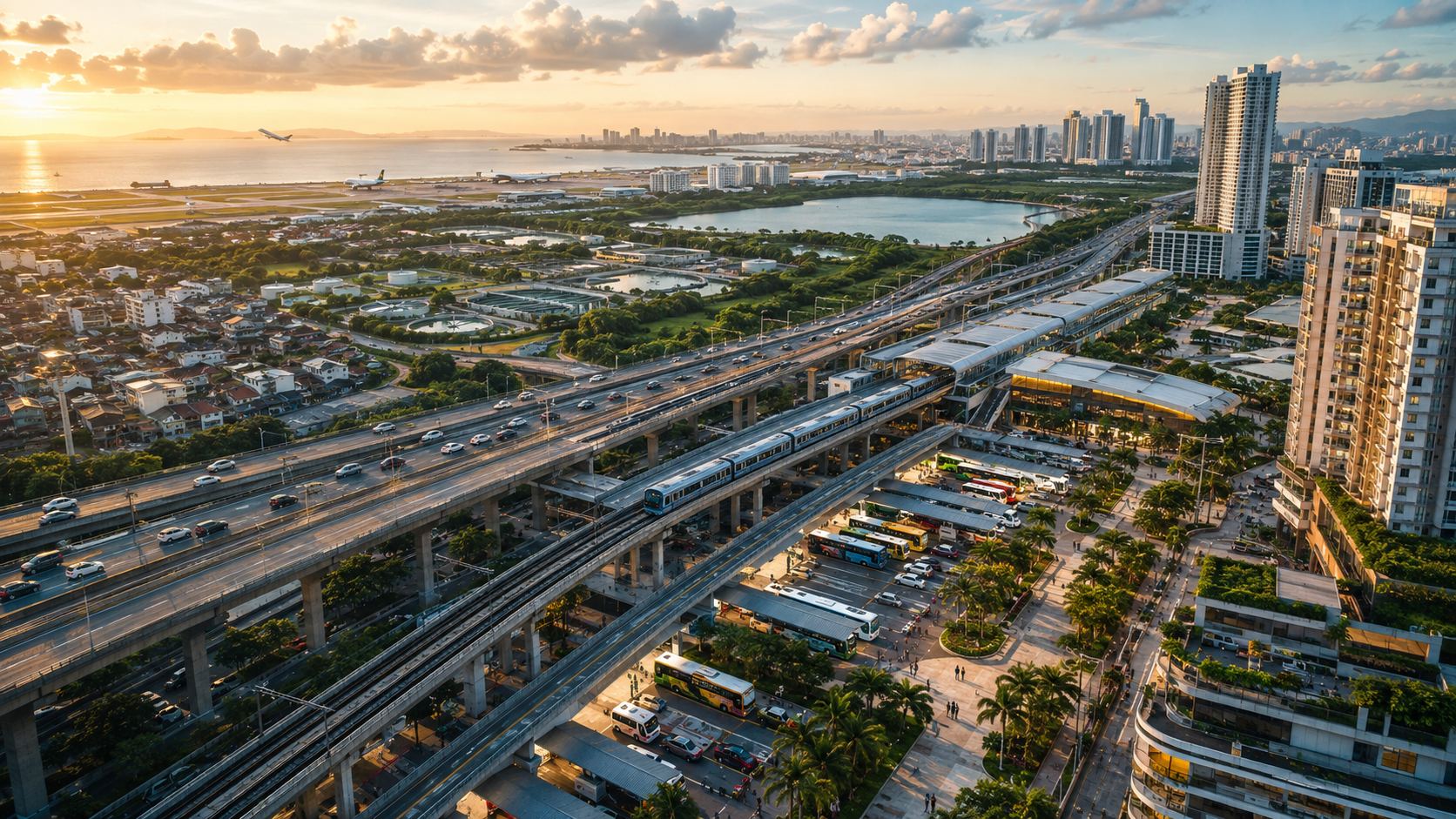
Rapid urbanisation in the Philippines is not just a demographic trend—it is a logistical emergency that demands swift, large-scale infrastructure responses. With public budgets strained, the country’s diversified conglomerates have stepped forward, reconfiguring cityscapes through airports, expressways, rail lines, and water utilities. Their projects are more than physical structures; they act as the skeletal system of future metropolitan regions, determining land use, property values, and economic accessibility for decades.
Why Private Companies Drive Urban Transformation
The Philippine Development Plan 2023-2028 explicitly calls for enhanced PPP mechanisms to accelerate infrastructure delivery. By mid-2026, the National Economic and Development Authority reported that 85 out of 186 flagship projects have active private partners, a ratio that underscores the government’s dependence on corporate execution capacity (https://neda.gov.ph/). Conglomerates bring to the table a combination of creditworthiness, engineering talent, and operational experience that individual state agencies often lack. This dynamic has turned firms like SMC, Ayala, Metro Pacific, Megawide, and Aboitiz into de facto city builders.
San Miguel Corporation’s Multi-Modal Network
SMC Infrastructure’s portfolio is anchored on the concept of seamlessness. The Skyway system, encompassing Stages 1 through 3, forms a fully elevated backbone that connects northern and southern mega-suburbs. MRT-7 will interface with the existing MRT-3 and LRT-1 lines at a common station in Quezon City, offering transfers between three rail systems. The New Manila International Airport in Bulacan is not merely a replacement facility; it is accompanied by a dedicated expressway, a future cargo city, and urban renewal programmes in surrounding towns. This integrated planning converts transportation assets into regional development anchors.
Ayala Corporation’s Livable Urban Districts
Ayala’s infrastructure philosophy extends the group’s real estate DNA into public realm investments. By aligning rail extensions with township developments, Ayala ensures that mass transit becomes an everyday amenity rather than a last-mile hardship. The LRT-1 Cavite Extension’s stations are directly linked to Ayala Malls, offices, and residential buildings, enabling a “live-work-play-commute” vertical urbanism. Manila Water’s continuous network expansion and non-revenue water reduction programmes, partly funded by development finance institutions, guarantee that urban density does not outstrip basic service capacity. In Cebu, the CCLEX bridge has given rise to new mixed-use nodes on Cordova’s coast, mirroring the growth pattern around the company’s Luzon toll roads.
Metro Pacific’s Arterial Corridors
Metro Pacific Investments Corporation (MPIC) has mastered the toll road as an urban development spine. Its NLEX and SCTEX network has transformed the Clark-Pampanga corridor into a logistics hub, attracting FDI in semiconductor and electronics manufacturing. The Cavite-Laguna Expressway (CALAX) opens up previously remote townships to Metro Manila’s labour market, increasing commuting radii and dispersing population pressure. MPIC’s subsidiary Maynilad Water Services supplies the western half of Metro Manila, including portions of Cavite, using bulk water sources and advanced treatment plants. This pairing of mobility and water security reinforces MPIC’s role as a holistic infrastructure steward.
Megawide’s Transport-Oriented Developments
Megawide’s construction heritage allows it to build faster and more efficiently using precast technology. The Mactan-Cebu International Airport’s second terminal introduced a biophilic design that reduces energy consumption while enhancing passenger comfort—a template now adapted for its school infrastructure programme. PITX, the country’s first landport, centralises bus operations, reduces curbside chaos, and includes commercial spaces that generate ancillary revenue. The terminal’s success has prompted proposals for similar intermodal hubs in key urban gateways, illustrating how a single well-engineered node can influence citywide transport planning.
Aboitiz InfraCapital’s High-Utility Enclaves
Aboitiz InfraCapital (AIC) targets the invisible layers of urban living. Its smart economic estates offer redundant power, water, and connectivity, making them resilient to natural calamities—a critical advantage in a typhoon-prone nation. The Laguindingan Airport upgrade integrates a digital remote tower, a first in the Philippines, enhancing safety and efficiency at minimal capital cost. AIC’s bulk water projects address the fact that many rapidly urbanising cities still lack 24-hour supply, turning water infrastructure into a platform for real estate and industrial expansion.
The 2026 NEDA data solidifies the narrative: privately led urban infrastructure is no longer an experiment but the dominant model for Philippine city building, delivering tangible improvements in commute times, water availability, and economic opportunity.