The Gap Between “Mayday” and the Responder
In the chaos of a Philippine disaster, the most dangerous moment is often the silence before help is called. A fire starts in a crowded residential block. A flood sensor detects rapidly rising water in a low-lying barangay. A resident sees a road collapse but has no direct line to the responders who need that information. The common thread is not a lack of responders or even a lack of technology—it is the absence of an automated bridge between detection and action. In 2026, two Filipino startups are building that bridge from opposite ends of the disaster communication chain.
Alerto PH and the Decentralized Command Center
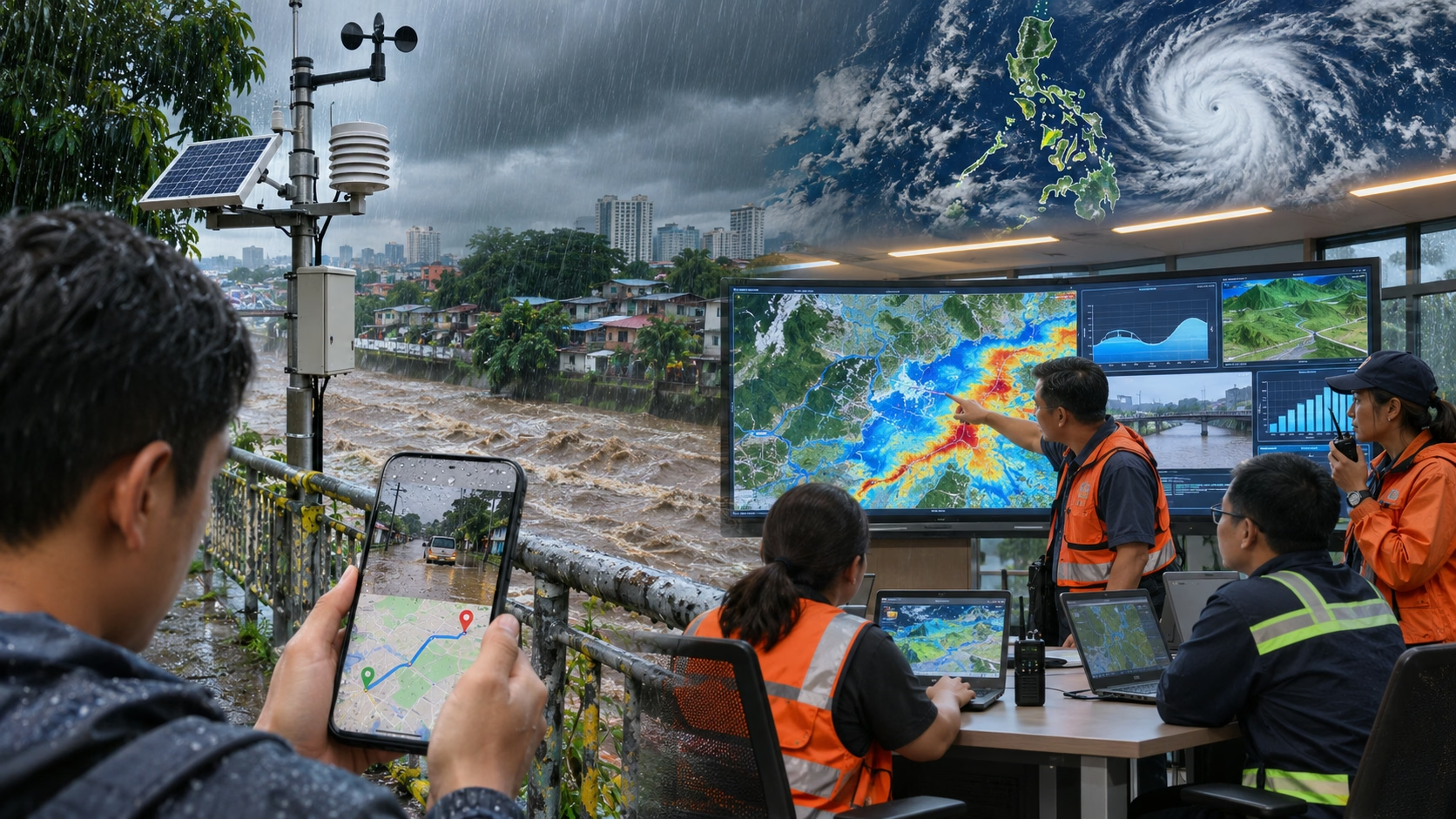
Developed by Filipina inventor Cristina Macaraig through her company Wiredfield Philippines Inc., Alerto PH is a mobile application that connects third-party devices—fire alarms, smoke detectors, gas alarms, flood sensors, CCTV cameras, and burglar alarms—to government emergency responders through a decentralized command center network. When a connected device detects danger, it can automatically trigger alerts to both the property owner and the nearest responders, even if no one is present to call for help. On the backend, the command center uses remote sensing, data aggregation, and AI to give local governments and emergency teams real-time information for faster, more coordinated response. The startup has begun pilot testing in Tagaytay and Quezon City, installing smoke alarms in fire-prone areas and flood detectors in vulnerable neighborhoods, with a goal of onboarding 100 LGUs. Macaraig’s diagnosis of the problem is direct: existing systems were “either too expensive, too complex, or simply not available for regular households,” leaving most communities reliant on outdated infrastructure or no emergency mechanisms at all.
Bagyo.App and the Citizen as Sensor
If Alerto PH automates detection at the device level, Bagyo.App attacks the problem from the citizen-reporting side. Launched in an early-access pilot in Naga City in June 2026, Bagyo.App is a citizen reporting platform and disaster intelligence layer designed to counter the spread of unverified social media posts and misinformation during severe disasters. The platform’s desktop coordination dashboard aggregates official data from PAGASA, NOAA flood maps, and NASA wind data alongside publicly sourced CCTV feeds and live news streams into a single terminal for first responders and volunteer networks. An AI engine called A.E.R.I.S. (Autonomous Emergency Response Intel System) automatically analyzes reports, classifies incidents, and guides users to the nearest evacuation center based on designated disaster playbooks. Notably, the architecture incorporates blockchain to create a tamper-evident audit trail for every report, while zero-knowledge proofs protect victim identities in compliance with the Data Privacy Act.
The Architecture of Trust
Both platforms confront a shared challenge that is as much social as technical: trust. Alerto PH must convince LGUs that automated alerts will not overwhelm responders with false positives. Bagyo.App must convince citizens that their reports will be verified and acted upon, not lost in a flood of noise. Their answers differ—Alerto PH leans on device-triggered certainty, Bagyo.App on layered verification and tamper-evident transparency—but the underlying principle is the same. In a disaster, information is infrastructure, and the startups that treat it that way are building the connective tissue of the next-generation Philippine emergency response system.